Blog
Workshop at UCA Epsom: Sharing the knowledge

Rachael Case is a designer at Deeson. Having graduated from UCA Epsom in 2010, she was invited back by her graphic design tutor, Sallyanne Theodosiou, to talk to current students about her transition into digital design. Here's her story:
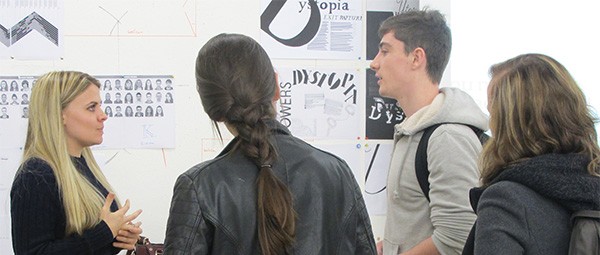
Last week I went back to UCA Epsom to present a two-part workshop to the first, second and third years on the Graphic Design course. For part one of my session I focused on my transition from print into digital design. With part two, I looked at how students could be inspired to create stylish CVs and personal web sites.
Part one: My transition from print to digital design
These days, graphic designers are not only expected to know Photoshop, Illustrator and InDesign but also digital design. We have to embrace this and evolve with technology, just as when letterpress was replaced by printers and the parallel motion with the computer. With this in mind, I shared my journey into digital.
My first passion at university was bookbinding where I had no connections to digital design, but following a meeting at my graduate show, I got the opportunity to sell my books at book fairs. That led to a placement at a publication house where I first noticed digital design in the publishing industry: they were rebuilding magazines on iPads. It really got my attention.
Soon after I got a job as a print designer at a design agency in Kent where I was illustrating, branding and creating magazines. This was in 2011, but by 2012 I saw a shift into digital. I knew I had to take the initative, so I started designing sites and email templates.
When I was ready to look for my next job, HTML and CSS was on most job descriptions – something I didn't have. But I did have aptitude, was creative and had a passion to learn new digital skills – exactly what the Deeson Group were looking for. It also helped that I had side projects, and could point to the sites I'd designed.
During the session, I emphasised to the students the need to learn HTML and CSS. I also stressed that they needed to network as a student and not just assume it was something they did on graduation. Instead they had to take every opportunity that came their way.
Part 2: Inspiring the students to create stylish CVs and personal web sites.
CVs
Many designers think CVs are supposed to look a certain way: An A4 piece of white paper with a boring list. What people forget is that design agencies get hundreds of these and the students needed to instead consider their CVs as a way to showcase their talent; they needed to tell a story and make it punchy.
Portfolios
Things have changed from just sending a clunky PDF that people have to wait to download and open. Instead, students need to use the web. But if they don’t feel confident to build their own site then they should use a platform that is easy to use. For example a Behance page would be a much easier way for people to view their work. After all, you should have fun with a portfolio!
I then left them with my top five tips:
-
Initially only submit 5-8 projects to an agency. When you have your first interview take 12-18.
-
Have personal projects outside of university or work.
-
Keep in contact with everyone you meet in industry. Email what you are doing and ask about opportunities in their companies.
-
Read design blogs, go to exhibitions, soak up everything. It makes you a more interesting designer and your ideas richer.
-
Use time in university to learn about digital design and take advantange of Lynda. It's a great online tutorial resource that not only the university is providing but is accessble for anyone.
Conclusion
I was really excited to go back to my university and talk to the current students. I hope they found some helpful hints from my successes and failures. Infact I think this extract from Smashing magazine sums up the role of a designer perfectly:
“It seems there is no place for the traditional print designer, but then again, nor is there a place for the traditional web designer who ignores our print design history. The modern designer is much more than a web, print, digital or visual designer. Perhaps the modern designer is one that embraces all forms of design to create content that ‘knows’ where it is and ‘lives’ and behaves in a way that brings us as humans, much closer to it.”
Add new comment